Ancient
Queen Sheba-Makheda
Axumite Empire · Horn of Africa & Arabian Peninsula
Known as Makeda in Ethiopian records and Bilqis in Arabian records — a single legendary sovereign whose influence bridged two continents.
Ancient empire building
Museum-quality classroom units, printable infographics, and slide decks designed with historians and teachers — free to download and share.
Curriculum Units
Unit 01 · Grades 4–12
Five sovereign queens across five regions and five centuries — power, resistance, heritage.
Unit 02 · Grades 4–12
Eight regional traditions — from Ife bronzes to Shona stone — decoded through material, ritual, and royalty.
Spotlight · Grades 4–12
The polymath king (1860–c.1933) who invented a writing system, built a school, and reimagined a kingdom.
Educator Guides
Educator Guide · PDF
The complete teacher's companion to the game: learning objectives, classroom activities, discussion prompts, and cultural context for every card set. Designed for grades 4–12.
Download Educator Guide (PDF)Glossary · PDF
A quick-reference guide to key names, places, dynasties, and cultural terms encountered across the game and lesson units. Print for the classroom or keep on hand while playing.
Download Glossary (PDF)Membership
Unlimited access to every lesson plan, slide deck, printable infographic, and downloadable classroom resource — new units added each month.
Explorer Club
$9.99/mo
Billed monthly · cancel anytime
Request an invitationOnline sign-up reopens soon
Unit 01 · Grades 4–12
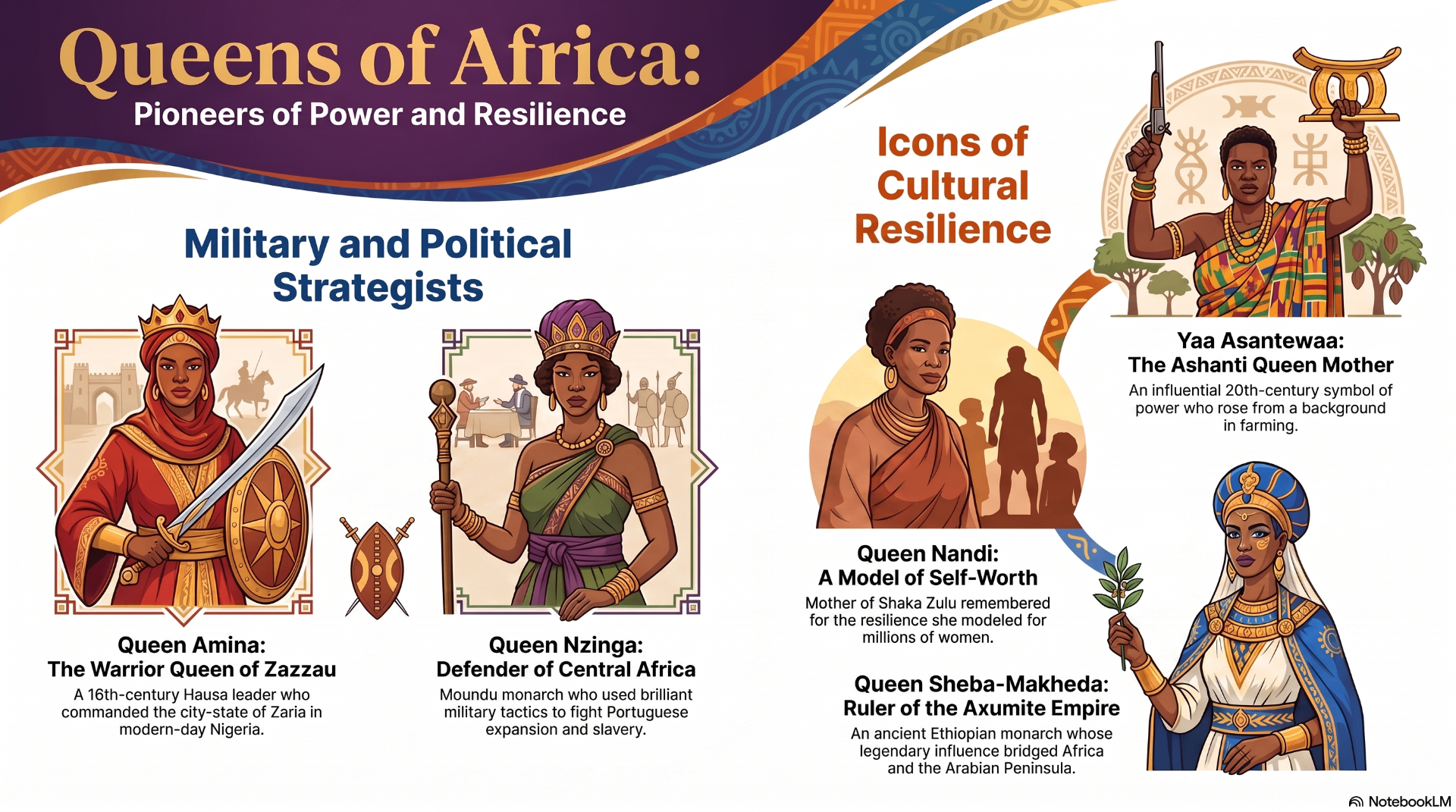
A five-part study of sovereign African queens spanning the Axumite Empire to 20th-century anti-colonial resistance. Students explore power exercised through military strategy, diplomatic negotiation, cultural preservation, and matrilineal authority.
Available in English and French, with printable infographics for classroom walls, library displays, and family reading.
Meet the Five Queens
Ancient
Axumite Empire · Horn of Africa & Arabian Peninsula
Known as Makeda in Ethiopian records and Bilqis in Arabian records — a single legendary sovereign whose influence bridged two continents.
Ancient empire building
16th Century (d. 1610)
Zazzau · present-day Zaria, Nigeria
The Hausa warrior queen who expanded the city-state of Zazzau through force of arms — her true biography woven with legend.
Direct military conquest
17th Century
Mbundu · Angola, Central Africa
A resilient tactician and diplomat who outmaneuvered Portuguese colonizers and resisted the expansion of the slave trade.
Guerrilla tactics & diplomacy
Born 1760 · Melmoth
Elangeni · Southern Africa
Mother of Shaka Zulu, celebrated in her own right as an enduring archetype of self-worth for millions of women.
Personal will & matriarchal resilience
1880s – Early 20th Century
Ashanti Empire · West Africa
A skilled farmer raised to Queen Mother — the enduring symbol of Ashanti cultural preservation and anti-colonial resistance.
Institutional matrilineal authority
Learning Objectives
Discussion Prompts
Downloads · Unit 01
PowerPoint · 10 slides
PowerPoint · 10 slides
High-resolution PNG · print-ready
PNG haute résolution · imprimable
Unit 02 · Grades 4–12
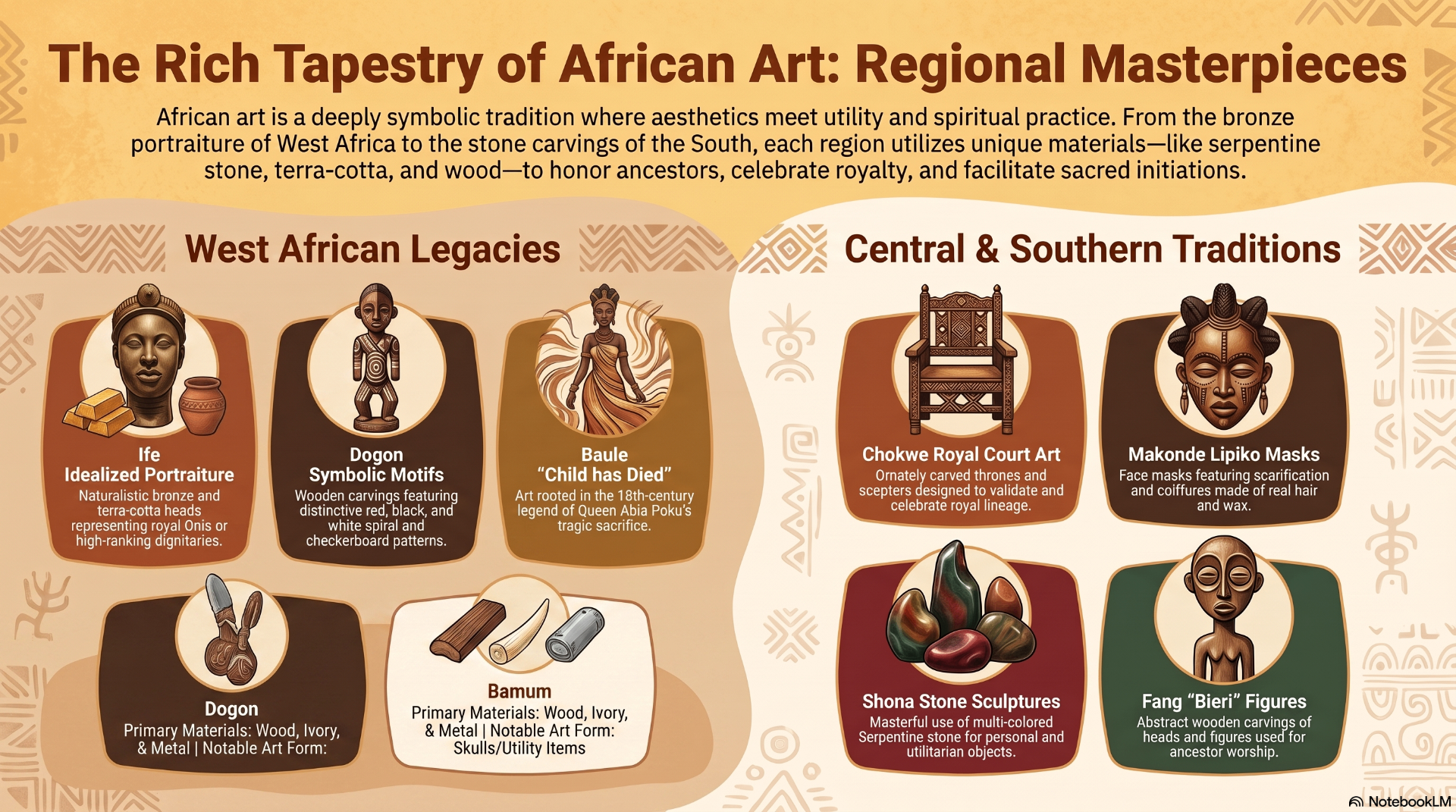
A journey through eight regional art traditions — from the naturalistic bronzes of Ife and the symbolic Dogon carvings of Mali, to Shona serpentine sculpture in Zimbabwe and Fang 'Bieri' ancestor figures in Gabon.
Includes a full slide deck, an illustrated PDF study guide, and printable infographics in English and French.
Eight Traditions
Yoruba · Nigeria
Life-like heads representing royal Onis and high-ranking dignitaries — masterworks in bronze casting and clay.
Naturalistic bronze & terra-cotta
Mali · West Africa
Wooden carvings with distinctive red, black, and white spirals and checkerboard patterns rooted in origin narratives.
Wood carving & cosmology
Côte d'Ivoire · West Africa
Art form born of the 18th-century legend of Queen Abia Poku's tragic sacrifice — sculpture as living memory.
Ritual sculpture
Cameroon · Central Africa
Under King Njoya, the Bamum developed one of Africa's earliest indigenous writing systems and a royal art of skulls and regalia.
Wood, ivory & metal
Angola / DRC · Central Africa
Ornately carved thrones and scepters designed to validate and celebrate royal lineage.
Thrones, scepters & regalia
Mozambique / Tanzania · East Africa
Face masks featuring scarification and coiffures crafted from real human hair and wax — startlingly lifelike initiation regalia.
Realist mask-making
Zimbabwe · Southern Africa
Masterful use of multi-colored serpentine stone for personal, spiritual, and utilitarian objects.
Serpentine stone carving
Gabon · Central Africa
Abstract wooden carvings of heads and figures used in ancestor worship and reliquary rites.
Abstract ancestor carving
Learning Objectives
Discussion Prompts
Downloads · Unit 02
PowerPoint · lesson slides
PDF · illustrated reference
High-resolution PNG · print-ready
PNG haute résolution · imprimable
Spotlight · Grades 4–12
1860 – c. 1933 · Cameroon
A polymath sovereign of the Bamum Kingdom in western Cameroon, King Njoya invented an original writing system, designed a hand-powered grain mill, founded a royal school, and drew intricate cartoons and manuscripts documenting his kingdom's history.
His life reframes 19th- and early-20th-century African history as one of indigenous invention, literacy, and architectural ambition — long before the tools of the modern nation-state arrived from elsewhere.
Download study sheet (.docx)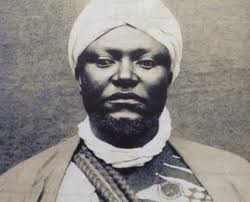
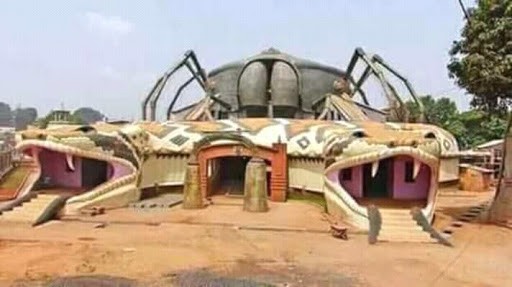
Architecture
The Bamum Royal Palace at Foumban — a monumental statement of royal identity and design.
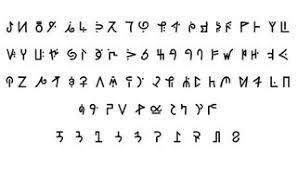
Bamum Script
An indigenous writing system developed by King Njoya — one of Africa's earliest home-grown scripts.
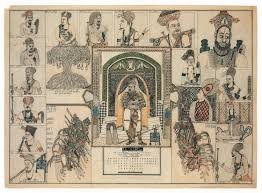
Visual Storytelling
King Njoya drew cartoons and illustrated manuscripts chronicling his kingdom's history and court life.
Innovations
Discussion Prompts
Extend the Lesson
Deepen each unit with hands-on materials — memory games, heritage dolls, and picture books that bring African history into the room.